

The Longevity Intervention We Often Overlook
What the latest longevity science can teach us about technology, movement, nature — and each other
I recently attended a conference focused on longevity and the rapidly evolving world of emerging technologies designed to help us live longer and healthier lives.
There was a lot to be excited about.
We talked about advanced diagnostics, biomarkers, wearables, metabolic optimization, cellular health, supplements, and technologies designed to help us understand—and potentially influence—the biology of aging.
As a physician who has spent much of my career thinking about prevention, root-cause medicine, and healthspan, I find this science fascinating. We are learning more than ever about the mechanisms of aging and the ways we may be able to intervene earlier to preserve health and function.
But there was one important longevity intervention that didn’t get nearly enough attention.
Other people.
Our relationships.
Our friendships.
Our families.
Our communities.
The simple act of being together.
The science of connection
One of the most remarkable findings from the Harvard Study of Adult Development is that the quality of our relationships is deeply connected to how we age.
The study began in 1938 with 724 participants and has followed participants across more than eight decades, making it one of the longest-running studies of adult health and well-being. When researchers looked back at what predicted who would be healthy and happy in their 80s, relationship satisfaction at age 50 was a stronger predictor than measures such as cholesterol levels at age 50.
Two numbers are particularly striking:
- The original study included 724 participants—268 Harvard College sophomores and 456 young adults from Boston—and has since expanded to include more than 1,300 descendants.
- Researchers found that people who were most satisfied with their relationships at age 50 tended to be the healthiest—both physically and mentally—at age 80.
The Harvard researchers’ conclusion isn’t that relationships are the only determinant of longevity. Diet, exercise, genetics, socioeconomic conditions, preventive care, sleep, and many other factors matter.
But relationships emerged as one of the most consistent and powerful predictors of healthy aging.
And the finding isn’t limited to the Harvard Study of Adult Development.


What about health professionals?
A separate study from the Health Professionals Follow-Up Study examined social ties among tens of thousands of U.S. male health professionals.
In one analysis, researchers followed 28,369 men ages 42–77 for approximately 10 years. Men with lower levels of social integration had a 19% higher risk of death compared with men who were more socially integrated, even after accounting for factors including health behaviors, physical condition, coronary risk factors, and diet.
An earlier analysis of the same broader health-professional cohort included 32,624 men and found that socially isolated men had approximately 1.9 times the risk of cardiovascular mortality and 2.2 times the risk of stroke compared with men with the strongest social networks.
These are observational findings, so they do not prove that social connection itself directly causes longer life. But taken together with decades of research from many populations, they make an increasingly compelling case that social connection belongs in our conversation about health and longevity.
Longevity isn't just about what happens inside our cells
I love the promise of longevity science.
Understanding our biology can help us identify risk earlier, personalize prevention, and make more informed decisions about our health.
But health doesn’t happen in a laboratory alone.
It happens around the dinner table.
On a walk with a friend.
In a conversation that makes us laugh.
When someone asks how we’re really doing.
When we have a sense of belonging and purpose.
And when we move our bodies.
Movement is Medicine
Walking is one of the simplest forms of physical activity, yet the evidence supporting movement and longevity is anything but simplistic.
A large pooled analysis of 654,827 adults from six prospective cohort studies found that even modest amounts of leisure-time physical activity were associated with longer life expectancy.
Two numbers stood out:
- The equivalent of up to 75 minutes of brisk walking per week was associated with approximately 1.8 additional years of life expectancy after age 40 compared with no leisure-time activity.
- Activity equivalent to 150–299 minutes of brisk walking per week was associated with approximately 3.4 additional years of life expectancy. At still higher activity levels, the estimated gain reached approximately 4.5 years.
Again, these are associations from observational cohort data—not a guarantee that walking a particular number of minutes will add a specific number of years to an individual person’s life.
But the message is encouraging:
You don’t have to do everything perfectly for movement to matter.
Some movement is better than none. And walking is accessible to many people across a wide range of ages and fitness levels.
And then there is nature
There is something uniquely restorative about stepping away from our screens, leaving the office, and walking beneath a canopy of trees.
And increasingly, research is giving us clues about why being in nature may feel so different.
One of the most studied mechanisms is our body’s stress response.
A 2019 systematic review and meta-analysis examined 22 studies of shinrin-yoku, or forest bathing, and included eight studies in its quantitative analysis. Across the studies, cortisol—a hormone involved in the body’s stress response—was generally lower after time spent in forest environments compared with urban environments. In the meta-analysis, salivary cortisol was significantly lower in forest groups both before and after the intervention compared with urban groups.
A broader 2020 systematic review looked at seven studies examining the physiological effects of nature exposure, including cortisol, blood pressure, skin conductance, heart rate variability (HRV), and other measures of autonomic nervous system activity. All seven studies found an inverse relationship between nature exposure and at least one physiological marker of stress.
Walking outdoors isn’t simply exercise.
It can be an opportunity to shift out of the constant stimulation of modern life and give our nervous system a chance to settle.
The studies reinforce something many of us intuitively know:
Where we spend our time matters.


What if we put all three together?
Connection.
Nature.
Movement.
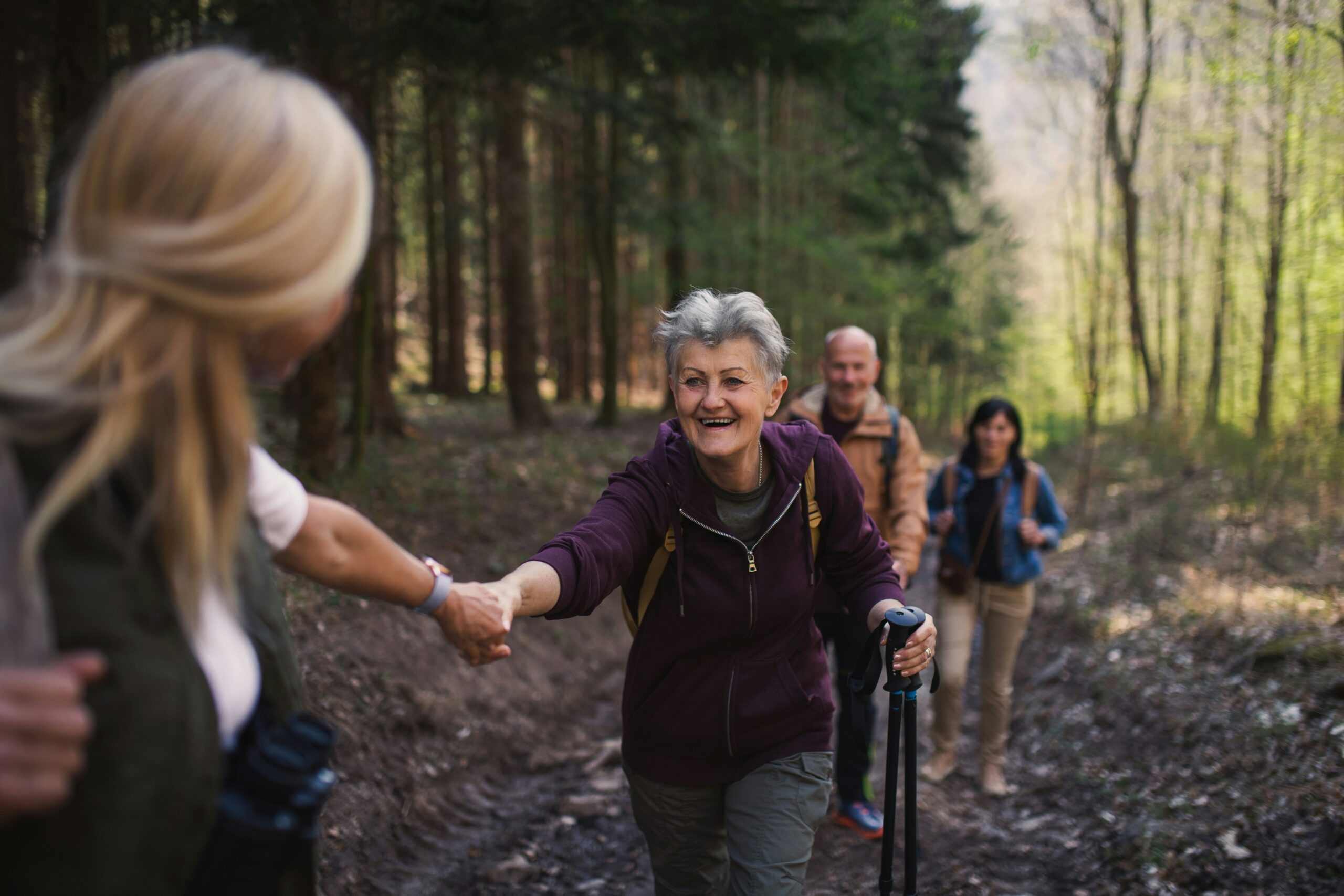
A walk outside with other people brings several ingredients of health together at once.
We move our bodies.
We spend time outdoors.
We step away from our screens.
We regulate stress.
We have a conversation.
We meet someone new.
We strengthen a relationship.
And we create a little more community in our lives.
That’s a pretty compelling longevity intervention—and it doesn’t require a wearable, a blood test, or a subscription.
Let’s put the science into practice
As the seasons turn and fall colors begin to appear throughout the Treasure Valley, I thought:
Why not gather?
Not for a lecture.
Not for another screen-based wellness program.
Not to optimize every biomarker.
Just to walk.
And talk.
And connect.
This October, I’m inviting you to join me for
Wellness Wednesday Walks
Every Wednesday in October
9:00–9:45 AM
Harrison Hollow Trailhead parking lot
We’ll walk together, enjoy the changing season, and have an open conversation about health and whatever is on your mind.
To learn more and register, please visit the registration page.
This October, I’m inviting you to join me for
Wellness Wednesday Walks
Every Wednesday in October
9:00–9:45 AM
Harrison Hollow Trailhead parking lot.
We’ll walk together, enjoy the changing season, and have an open conversation about health and whatever is on your mind.
To learn more and register, please visit the registration page.
We are not meant to live—or age—alone
The more we learn about longevity, the more complicated the science becomes.
There are fascinating questions about cellular senescence, epigenetics, mitochondrial function, metabolic health, inflammation, and emerging technologies that may eventually change how we approach aging.
I’m excited about all of it.
But I don’t want us to become so focused on optimizing the biology of aging that we forget the biology of being human.
We need movement.
We need nature.
We need meaningful relationships.
We need people who know us, people we can laugh with, people we can lean on, and places where we feel that we belong.
So this fall, let’s make time for something beautifully simple.
Let’s walk.
Let’s talk.
Let’s connect.
And maybe, together, we’ll discover that one of the most meaningful longevity interventions isn’t something we can buy.
It’s community.
—Ning Tang, MD
Tang Wellness | Medicine Re-imagined